
About Gardopia Gardens
Gardopia Gardens is a 501(c)3 nonprofit organization based in the Near East of San Antonio, founded in May 2015.
Effective interventions are needed to address the growing epidemic of obesity-related diseases and environmental issues. Gardopia Gardens aims to reduce obesity and malnutrition by increasing accessibility to fresh produce and implementing strategic intervention programming in schools, businesses, and community organizations.
Gardopia Gardens provides programs and services to educational, commercial, and residential communities, providing tools, materials, and best practices to ensure their sustainability.


MISSION
Growing healthy communities through garden-based learning.
VISION
A sustainable society, empowered and educated to lead healthy lifestyles through gardening.
CORE VALUES
Education. Health. Environment.

Annual Reports
Gardopia Gardens is proud to present to you our 2023-2024 Annual Report, which highlights the many efforts taken together to support health through the expansion of urban agricultural initiatives in the Greater Bexar County Area.
We extend our sincerest appreciation and gratitude to the community for your endless support of growing healthy communities through garden-based learning. Every volunteer, partner, donor, and advocate of Gardopia Gardens advances healthier outcomes for the community-at-large.
We're asking for your donation of $5 - $100 /month to help us grow and maintain our garden-based wellness programming. Your tax-deductible donation to Gardopia Gardens will directly impact the education, health, and environment for thousands of youth and adults in Central Texas!
-Stephen Lucke, CEO / Founder
Historical Archive
2022 - 2023 Annual Impact Report
2021 - 2022 Annual Impact Report
.png)

Executive StafF

Chief Executive Officer
Stephen Lucke, MA
Founder & CEO Stephen Lucke holds a Bachelor of Science in Biochemistry and a Master of Arts in Multidisciplinary Studies from the University of the Incarnate Word, where his undergraduate years ignited a passion for health and wellness through hands-on leadership, student and employee initiatives, and the creation of a thriving campus community garden.
A native San Antonian, Stephen founded Gardopia to address obesity and climate change through community-based solutions. His background includes certification as a strength and conditioning specialist in 2015, a 2017 mayoral campaign, Organic Farmer certification in 2019, and currently attending NASA’s Community College Aerospace Scholars program as an Aspen Institute Healthy Communities Fellow.
Boards & Commissions:Board Member, Food Policy Council of San Antonio

Chief Operating Officer
Dominic Dominguez, MA, LEED GA
Dominic Dominguez, a San Antonio native, holds a Bachelor of Science in Environmental Science & Policy with a specialization in Biology from St. Edward’s University and a Master’s degree in Sustainability & Development from Southern Methodist University. He is currently a Ph.D. student at the University of Texas at San Antonio studying Environmental Science and Engineering.
Dominic is a Certified Master Gardener and Master Wellness practitioner through Texas A&M AgriLife Extension in Bexar County and a Clinton Global Initiative University alumnus. His academic and professional interests include spatial design, urban planning, applied research, GIS analysis, 3D modeling, regenerative infrastructure, and equity expansion.
Boards & Commissions: Appointed to the City of San Antonio Planning Commission Technical Advisory Committee (2022); Board Member, Democracy Prep Texas; Chair of Community Conservation Committee, San Antonio Water System.

Chief Learning Officer
Sherry Lim, M.Ed
Sherry Lim has been passionate about teaching since 2006 and brings two decades of experience in education, curriculum design, and environmental learning. She holds a Master of Education in Curriculum and Instruction from University of Texas at San Antonio and a Bachelor’s degree in Biology from University of Texas at Austin.
Sherry is a certified organic gardener, beekeeper, master composter, and science educator who is deeply committed to inspiring students of all ages to grow their own food and understand the systems that sustain it.
As Chief Learning Officer at Gardopia Gardens, Sherry leads the development and implementation of educational programming and curriculum rooted in environmental education, TEKS alignment, and sustainable living for diverse learners. Her areas of expertise include local food systems, food cultivation, composting and food-waste prevention, and practical waste-reduction strategies that can be applied in everyday life.
Staff Members

Nina Pandya, J.D.
Lead Garden Educator
_edited.jpg)
Arlene Castro
Garden Educator

Sarah Olivarez
Grant Writer

Vanessa Sanchez
Accountant

Lisa Shelton
Development Coordinator

Emiaj Castaneda
CEO Assistant

Therese Shields, M.Ed
Grant Writer
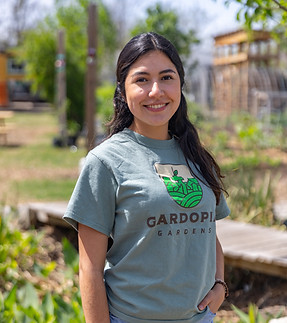
Taylor Camacho
Garden Educator
_Portrait%20(1).avif)
Brodie Flores
Lead Garden Steward
_Portrait.jpeg)
Jodi Cruz
Farmers Market Coordinator/ Garden Educator

Marcos Pena
Media Producer

Cayla Hernandez
Garden Educator

Jacob Benn
Garden Steward

Benjamin Hanson
Garden Steward
Board Of Directors - Executive Committee
Andres Narvaez, Board Chair, Director of Business Development / Professional Relations, Stonegate Pharmacy
Michelle Duenas, Board Vice-Chair, Manager of Donor Relations, San Antonio Food Bank
Brittany Ireland, Board Secretary, Development Manager, BIG We Foundation
Samuel Chapper, MS, Board Member - Adjunct Faculty Instructor, New York University
Board Of Directors
Catalina Schultze-Kraft, MS, Board Member, Director of Regional Nursing & Wellness Programs, Methodist Healthcare Ministries
Erica Lee, Board Member, Registered Nurse, Home Health, IV Infusion Therapy
Dr. Ana Carla Cepeda-López - MD, PHD, MSc, Board Member, Assistant Professor of Nutrition, UIW, Clinical Researcher at TEC, Hospital Zambrano Hellion.
Tommi Ayala - Board Member, HR Specialist, Texas Tribal Buffalo Project
Abigai Salazar M.Ed., MHM, Board Member Sustainability Supervisor.
Carolina Fuentes, MA, Program Coordinator, Texas A&M University-San Antonio

In the news
-
November 2025 - Stephen Lucke reveals how Gardopia fights food insecurity
-
September 2025 - Listen: Could gardens be the key to a healthier, safer San Antonio?
-
August 2025 - Planting Change in San Antonio through Community Gardens
-
June 2025 - Inclusive gardening takes root in San Antonio with new project
-
June 2025 - Gardopia Gardens Grows Resilient Communities Through School Gardens and Urban Ag
-
June 2025 - Twelve Texas organizations receive 2025 Community Challenge Grants
-
May 2025 - Math and science skills in the garden help students grow
-
May 2025 - Urban Farm Wants to Add Housing, Short-Term Rentals to Creat 'agrihood'
-
December 2024 - Gardopia Gardens looks to grow housing, ‘agrihood’ on San Antonio’s East Side
-
November 2024 - Gardopia Gardens: The Only Thing That Stays the Same Here is Change
-
July 2024 - San Antonio Area Foundation boosts youth, cultural programs with $1.5 million investment
-
June 2024 - Celebrate Juneteenth with these events across Texas
-
June 2024 - Juneteenth is upon us! Here's how you can celebrate in San Antonio
-
April 2024 - Gardopia Gardens, Big Green partner for sustainable food event in San Antonio
-
April 2024 - Gardopia Gardens hopes to inspire a 'greener' lifestyle on San Antonio's east side
-
March 2024 - So you want to start a community garden? Here's what you need to know.
-
February 2024 - Madison Elementary starts $250k garden partnership for healthier San Antonio
-
January 2024 - East Side garden making sure community has fresh produce, is growing microgreens
-
July 2023 - Urban farms find success amid ongoing drought, extreme heat in San Antonio
-
January 2023 - San Antonio nonprofit is fighting food insecurity with Aquaponics
-
November 2022 - San Antonio community garden grows with new farmers market and tree giveaway
-
October 2022 - Young girls learn how to farm with the tap of a screen
-
September 2022 - Area nonprofit works with schools to build gardens, teach kids about healthy eating
-
June 2022 - Education, art, music and baseball to be part of San Antonio’s Juneteenth celebrations
-
May 2022 - New event farmers market and movie night sprouts on San Antonio's Northeast Side
-
April 2022 - Ready, set, grow: Gardeners compete to get the most out of urban food plots
-
April 2022 - Earth Day events in San Antonio you can enjoy with family, friends
-
February 2022 - Basura Bash: Time to grow San Antonio’s annual litter cleanup
-
February 2022 - Commentary: Fed by 40 loaves, a garden grows
-
February 2022 - Growing Minds and Gardens with Gardopia Gardens
-
December 2021 - Local spending of federal funds must align with community needs
-
December 2021 - My Kids Need the Outdoors, and I Need Help Giving It to Them
-
November 2021 - After slow start, San Antonio’s climate change plan may finally be gaining traction
-
September 2021 - Gardopia Gardens Host Community Food Pantry
-
August 2021 - The growth of Gardopia’s gardens continues with the juice, in the community kitchen
-
April 2021 - New group River Aid San Antonio forms, cleans Mission Reach
-
February 2021 - 10 Things to do in San Antonio This Valentine’s Day Weekend
-
February 2021 - Seeing lots of dead plants in your yard? Here are free resources to help
-
December 2020 - Gardopia Gardens offers gardening tips for winter season
-
September 2020 - 10 Things To Do in San Antonio This Weekend Sept. 24 - 27
-
August 2020 - How Gardopia is growing healthy communities through garden-based learning
-
June 2020 - San Antonio will celebrate Juneteenth with marches, online discussions
-
May 2020 - Six Eastside Small Businesses & Non-profit Granted $33K
-
March 2020 - There’s never been a better time to grow your own food.
-
March 2020 - Gardopia Gardens discusses spring growing and urban agriculture
-
February 2020 - Snooze celebrating National Pancake Day with 7 days worth of specialty pancakes
-
November 2019 - Gardopia Gardens educates on leading healthy lifestyles
-
November 2019 - San Antonio Garden Sets Out to Eliminate "Food Swamps"
-
November 2019 - Inner-city gardener fighting to replace fast-food mind set
-
November 2019 - San Antonio veterans find newfound purpose at community garden
-
May 2019 - Community event at east-side garden looks to unite neighbors after violent week
-
April 2018 - "Fiesta Bread" Campaign to Raise Fund for Local Nonprofits - Gardopia Gardens
-
December 2017 - Superstar Volunteers Shine at Awards Ceremony Honoring Eastside Community
-
November 2017 - "Bridging The Gap" Uplifting Eastside Amid Growing Violence
-
June 2017 - New Butterfly Garden Opens at Yanaguana Gardens at Hemisfair Park
-
October 2016 - Chefs to Host Benefit Dinner to Support Eastside Garden
-
August 2016 - This town is tackling education, nutrition, and crime by growing fruits and veggies.
-
November 2015 - Solar Fest Shines Light On Sustainability (Rivard Report)
-
May 2013 - University of the Incarnate Word Student Grows a Community

Organic gardening series

HEALTH & NUTRITION
-
Plant Based Diets
-
Eating more plant-based foods can significantly decrease the risk of cardiovascular disease, obesity, and diabetes. You don't have to become 100% vegan or vegetarian to adopt this lifestyle. Some easy ways to integrate a plant based diet is by eating meat only one time per day, practicing "Meatless Mondays", and replacing recipes with meat with mushrooms, which have a similar and taste texture to animal protein.
-
Benefits
-
Decrease anxiety & tension
-
Decreased risk for cardiovascular disease
-
Decreased risk for diabetes and obesity
-
Increase in a positive mood
-
Increase in energy
-
Decrease in anger and hostility
-
Increase in antioxidants
-
Improved digestion
-
-
-
Hydration
-
Many Americans do not drink enough water on a daily basis. With many alternative liquids, such as soda, juice, and alcohol, it's easy to become dehydrated. Below are some tips on how to stay hydrated, and the benefits of proper hydration!
-
Water helps prevent dry mouth
-
Water promotes a healthy blood composition
-
Water allows for proper perspiration, which keeps the body core temperature at 98 degrees
-
Water helps keep the skin elastic and youthful
-
Water helps prevent muscle cramps
-
Water helps remove toxins from the body
-
The body is ~55% - 75% water
-
Try drinking a glass of water every morning when you wake up, and every evening when you go to sleep
-
Instead of drinking 100% juice, try diluting the juice with 50% water
-
Avoid soda as much as possible
-
A good alternative to sports drinks is coconut water
-
Carrying a reusable water bottle can significantly improve water consumption
-
-
-
Fruits & Vegetables
-
Increased fruit and vegetable intake has a plethora of health benefits. Below are a few benefits, and ideas to increase your consumption
-
Fruits and vegetables are high in soluble and insoluble fiber, which can increase blood lipid profiles
-
Fruits and vegetables have simple and complex sugars, which can satisfy your sweet tooth, improve digestion, and provide sustained energy
-
Fruits and vegetables lower your carbon footprint, since it takes less water and energy to grow than animal products
-
Fruits and vegetables contain unsaturated fats, which can decrease high cholesterol and hypertension
-
Try to make at least 75% of your diet from fruits and vegetables to see an increase in energy and health
-
-
-
Whole Grains
-
Whole grains are packed with nutrients including protein, fiber, B vitamins, antioxidants, and trace minerals (iron, zinc, copper, and magnesium).
-
A diet rich in whole grains has been shown to reduce the risk of heart disease, type 2 diabetes, obesity, and some forms of cancer.
-
Whole-grain diets can also improve bowel health by helping to maintain regular bowel movements and promote growth of healthy bacteria in the colon.
-
-
Unsaturated Fats
-
These fats help reduce the risk of high blood cholesterol levels.
-
Unsaturated fats are liquid at room temperature
-
Great sources of unsaturated fats are nuts, avocados, and fish
-
-
Plant Protein
-
It doesn’t matter which type of diet you follow, the addition of legumes, nuts, and seeds gives you a nutritional advantage.
-
Beans, peas, nuts, seeds, soy, and lentils, are some of nature’s treasures. They are a powerhouse of good nutrition, a good source of plant protein, loaded with disease fighting phytonutrients, cholesterol-lowering fiber, and naturally low in cholesterol and sodium.
-
A diet focusing on plant-based protein sources can be beneficial for helping to prevent diabetes, cardiovascular disease, and mortality, explained Harvard professor, Frank Hu, MD, Ph.D., during a recent educational session at the Academy of Nutrition’s annual meeting in Atlanta.
-
Adults need between 46 and 56 grams of protein daily, approximately 10-35 percent of calories.
-
When cutting calories, it is essential to load up on healthy foods. Adding plant protein is a strategy that may help to get weight loss results.
-
Plant proteins are digested slowly which keeps you satisfied longer so you can cut calories.
-
-
-
Sources
-
https://www.onemedical.com/blog/live-well/6-benefits-of-staying-hydrated/
-
https://www.webmd.com/food-recipes/features/reap-the-benefits-of-whole-grains#1
-
https://www.prod-app.uhc.com/health-and-wellness/nutrition/power-of-plant-protein
-
https://www.prod-app.uhc.com/health-and-wellness/nutrition/power-of-plant-protein